How do you choose car rental software?
Choosing car rental software means evaluating it against your operational model - not just your current size. The platform must handle multi-branch dispatch, driver coordination, SLA enforcement, and HQ visibility today, and support franchise or multi-country expansion without a rebuild.
8 criteria for evaluating car rental software
Most car rental software vendors lead with booking and payment features. Those are table stakes. The criteria that separate platforms built for growth from tools that create bottlenecks at scale are operational.
Active Branch Dispatch Console
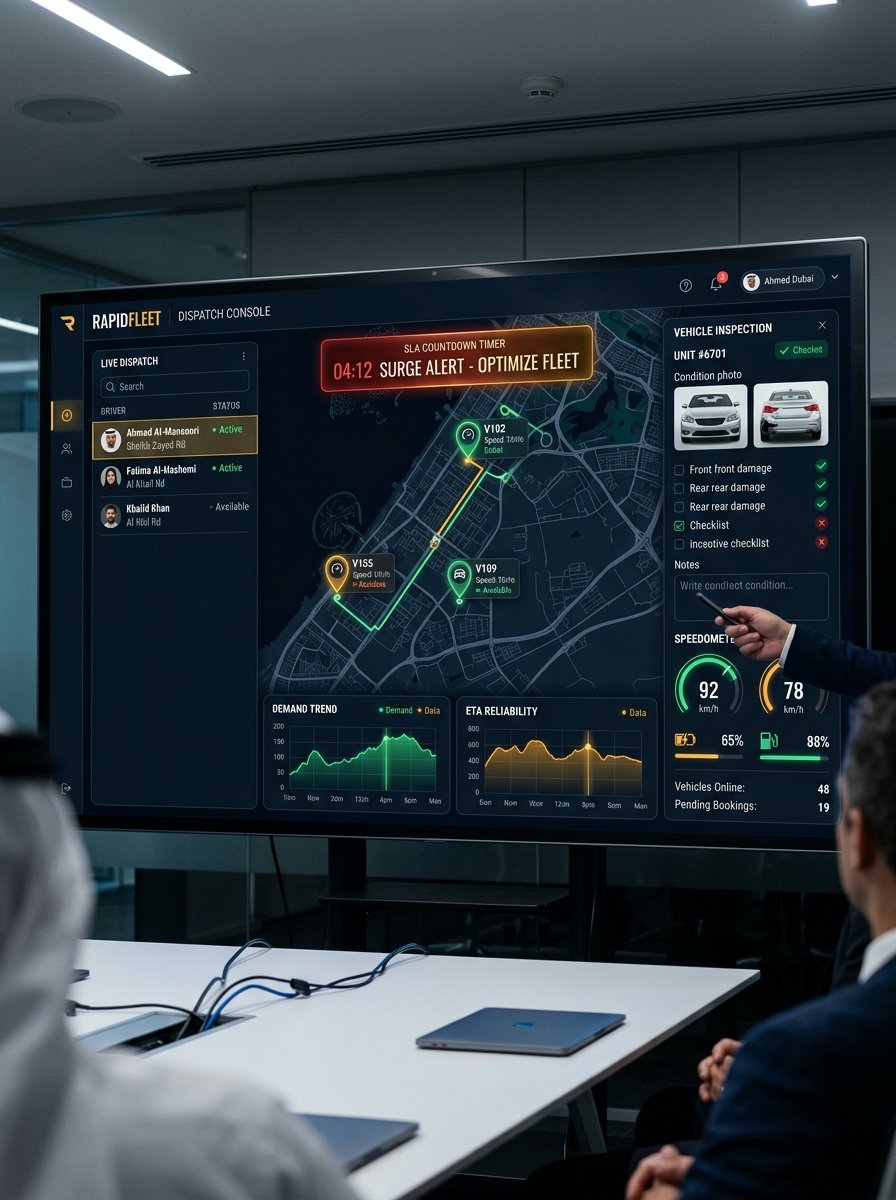
Not just a static reservation list, but a live dispatch workflow with active SLA countdown timers, driver task queues, and instant vehicle reassignment.
Dedicated Driver Execution Mobile App
Mobile trip lifecycle management for drivers with pre-trip digital inspections, GPS geofencing, fuel/odometer logging, and offline photo capture.
Booking-to-Delivery SLA Enforcement
Granular countdown timers on vehicle turnaround, cleaning, and delivery with automated escalation alarms before service breaches impact customers.
Fraud Detection & Tariff Override Auditing
Real-time telemetry monitoring for unauthorized rate discounts, contract alterations, mileage rollbacks, and unusual booking patterns.
Unified Multi-Branch Real-Time HQ View
Executive command center displaying pooled fleet inventory across airport counters, city branches, and overflow holding lots.
Multi-Country Architecture (SAR & QAR)
Native multi-currency accounting with automated ZATCA Phase 2 e-invoicing for Saudi Arabia and MOT transport compliance for Qatar.
Multi-Tenant Franchise Isolation
Independent tenant workspaces for regional franchise partners with master HQ audit rights, shared fleet telemetry, and automated royalty splits.
Advisory AI with Human Sign-Off
Machine intelligence that forecasts seasonal demand peaks and recommends dynamic pricing without removing operator control or human approval.
Why the dispatch console matters most
The dispatch console is where car rental operations live or die. A booking system confirms reservations. A dispatch console turns those reservations into operational commitments with SLA timers running, vehicles allocated, drivers assigned, and exceptions managed. Operators evaluating car rental software often focus heavily on the customer-facing booking experience - which is important - but underweight the dispatch layer, which is where SLA breaches happen, where fraud develops, and where multi-branch coordination breaks down. When evaluating any platform, ask to see the dispatch console under a simulated booking surge with three vehicles competing for two open time slots and an SLA timer in the red zone.

Questions to ask vendors during a demo
A structured demo agenda reveals more about a platform's capabilities than any feature list or marketing document. The best demos are scenario-driven, not feature-driven.
Evaluating total cost of ownership
Car rental software total cost of ownership (TCO) goes beyond the licence or subscription fee. Implementation and data migration, staff training, integration maintenance with any remaining external tools, and the ongoing cost of manual work the software does not automate all need to be factored in. Platforms that charge per booking or per vehicle create cost structures that penalise growth - as booking volume increases, so does the software cost, compressing margins. Platforms with flat deployment-based pricing have predictable costs that do not scale against revenue. When comparing proposals, model the cost at your current booking volume, at two times that volume, and at five times - the shape of the curve matters as much as the starting point.
| Cost & Architecture Metric | Legacy Desktop ERP | Commission SaaS (3–5% GMV) | FleetQore Mobility OS |
|---|---|---|---|
| Pricing Model | High upfront capital license + annual maintenance | Per-booking fee that grows with your fleet revenue | Predictable flat monthly platform tier |
| 5x Booking Growth Impact | Expensive manual database server upgrades | 5x higher platform toll fee (compresses net margins) | 0 SAR/QAR commission penalty (unlimited upside) |
| Curbside Driver Mobile Apps | None (Phone calls, SMS & paper condition sheets) | Third-party add-on app with extra per-driver seat fees | Native driver execution & digital inspections included |
| GCC Regulatory E-Invoicing | Manual batch exports to external tax filing tools | Generic Western tax logic without live integration | Built-in ZATCA Phase 2 (KSA) & MOT (Qatar) compliance |
| Cross-Branch Inter-City Telemetry | Siloed counter databases requiring manual phone transfers | Limited GPS tracker plugins without inventory pooling | Real-time pooled stock across airports & city counters |
Implementation and migration considerations
Moving from an existing car rental system to a new platform involves two parallel workstreams: data migration (historical bookings, customer records, vehicle data, driver profiles) and operational transition (staff training, process documentation, go-live support). Platforms that do not offer structured implementation support create a high risk of adoption failure - even well-designed software delivers no value if branch staff revert to existing tools after two weeks. Evaluate the vendor's implementation methodology: how is data migrated, who trains branch staff, what go-live support is provided, and what SLA does the vendor offer for issue resolution in the first thirty days.
Data Extraction & Cleansing
Clean structured import of active vehicle registries, corporate rate sheets, customer KYC, and blacklists.
- Automated legacy ERP schema mapping
- Vehicle VIN, mileage & service audit
- Active contracts & tariff migration
Platform Config & Policy Rules
Setup counter dispatch workflows, driver credentials, branch geofences, and ZATCA / MOT integrations.
- Custom regional SLA countdown timers
- Role-based access & audit controls
- ZATCA Phase 2 & MOT gateway validation
Pilot Branch Benchmark
Deploy live on a single high-traffic airport counter or hub to validate staff turn speed and driver mobile adoption.
- Side-by-side transaction verification
- Curbside driver inspection stress test
- Counter turnaround SLA benchmark
Fleet-Wide Cutover
Roll out across remaining city branches, airport hubs, and franchise partners with zero counter downtime.
- Zero-downtime legacy sync freeze
- Unified multi-branch HQ live view
- 24/7 dedicated engineering SLA support
How FleetQore addresses you choose car rental software
FleetQore is a mobility operating system built for car rental companies, corporate fleet operators, franchise networks, and chauffeur services across Saudi Arabia, Qatar, and the wider GCC. Every capability described in this guide is part of the same platform - booking, dispatch, driver execution, HQ governance, AI forecasting, and multi-country franchise management run on one shared data backbone.
The practical consequence for operators is that the problem addressed in this guide does not exist in isolation. A solution that handles only one layer - only booking, or only GPS tracking, or only dispatch - leaves the operator with integration overhead and data gaps that show up as SLA breaches, booking conflicts, and governance blind spots. FleetQore resolves this by connecting every layer: the booking event drives dispatch, dispatch connects to the driver app, the driver app feeds the audit trail, and the audit trail surfaces in the HQ Control Center in real time.
For operators in Saudi Arabia, this architecture is especially relevant in the context of Vision 2030: the giga-projects, expanding pilgrimage transport corridors, and growing corporate mobility sector create fleet management requirements at a scale and complexity that disconnected tools cannot serve reliably. For operators in Qatar, the post-2022 corporate mobility expansion has permanently elevated the standard that fleet software must meet - in dispatch speed, SLA compliance, corporate billing, and real-time governance.
FleetQore is not a point solution. It is the infrastructure layer for a fleet business that intends to scale - across cities, across countries, and across business models. The capabilities described in this guide are available from day one, on one platform, with one operator login, and one HQ dashboard that covers every branch and market you operate in.
◆Built for GCC operators
Multi-currency (SAR, QAR), Arabic roadmap, KSA VAT compliance, Qatar corporate billing, and GCC-calibrated demand forecasting built in from day one.
◆Scales with your operation
Single-branch to multi-country franchise deployment. No rebuild required when adding a new city or market - it is a configuration exercise, not a software project.
◆Advisory AI, human control
Every AI recommendation - demand forecasting, risk scoring, driver assignment - requires human approval. No automated actions are taken without your explicit sign-off.
- The concepts in this guide are built into FleetQore as integrated capabilities - not bolt-on modules that require separate configuration or third-party integrations.
- FleetQore is designed for operators who run multiple branches, multiple product lines (car rental, chauffeur, corporate), or multiple countries from one platform - without juggling separate systems per market.
- Every piece of operational data - bookings, dispatch events, driver actions, vehicle status, SLA outcomes, financial settlements - feeds the same audit trail and HQ dashboard in real time.
- The platform is available to operators in Saudi Arabia, Qatar, and across the GCC, with support for the regulatory and commercial requirements of each market built into the configuration layer rather than requiring custom development.
- To see the capabilities described in this guide demonstrated in your operational context, book a live demo using the link below. FleetQore runs platform walkthroughs specific to your fleet type, branch count, and geographic markets.
- Implementation timelines are determined by your current systems, data migration scope, and branch count - not by FleetQore's technical architecture, which is designed for fast deployment without lengthy customization cycles or vendor-lock integration work.
Frequently asked questions about selecting car rental software
Should car rental software include a driver app?
Yes. Without a dedicated driver app, dispatch relies on phone calls and manual updates. A connected driver app closes the loop between branch assignment and trip execution - with inspection records, digital signatures, and incident reports attached to the booking.
Is cloud-based car rental software more reliable than on-premise?
Modern cloud platforms provide higher availability, automatic updates, and easier multi-location access than on-premise deployments. FleetQore is cloud-native with a microservices architecture and redundant infrastructure.
How do I know if a car rental platform can handle my booking volume?
Ask the vendor for reference operators at your booking volume and above, and for their stated SLA for platform uptime and response time. FleetQore is built on a microservices architecture with horizontal scaling - capacity grows with demand without configuration changes.
What should I look for in car rental software for GCC operators?
GCC-specific requirements include SAR/QAR multi-currency billing, VAT-compliant invoicing for Saudi Arabia, Arabic-compatible customer interfaces, and demand forecasting calibrated to seasonal patterns including Hajj, Umrah, and regional events. Generic platforms designed for Western markets frequently lack these capabilities.
Get our Car Rental Software RFP & TCO Kit
Request our 50-point technical vendor evaluation matrix and spreadsheet model customized for GCC car rental and corporate fleet operators.
- 50-point technical & dispatch RFP matrix
- Fleet TCO financial forecast (SAR/QAR)
- Saudi ZATCA Phase 2 & MOT compliance guide
More from the FleetQore knowledge base
Fleet management insights, delivered.
Practical guides for car rental and fleet operators in Qatar and Saudi Arabia. No spam - unsubscribe any time.
- Weekly mobility operator intelligence & fleet management benchmarks
- Saudi Vision 2030 & Qatar corporate mobility case studies
- Zero spam. Directly actionable operational strategies for GCC fleets
Subscribe to Insights
Get exclusive fleet management strategies directly in your inbox.